
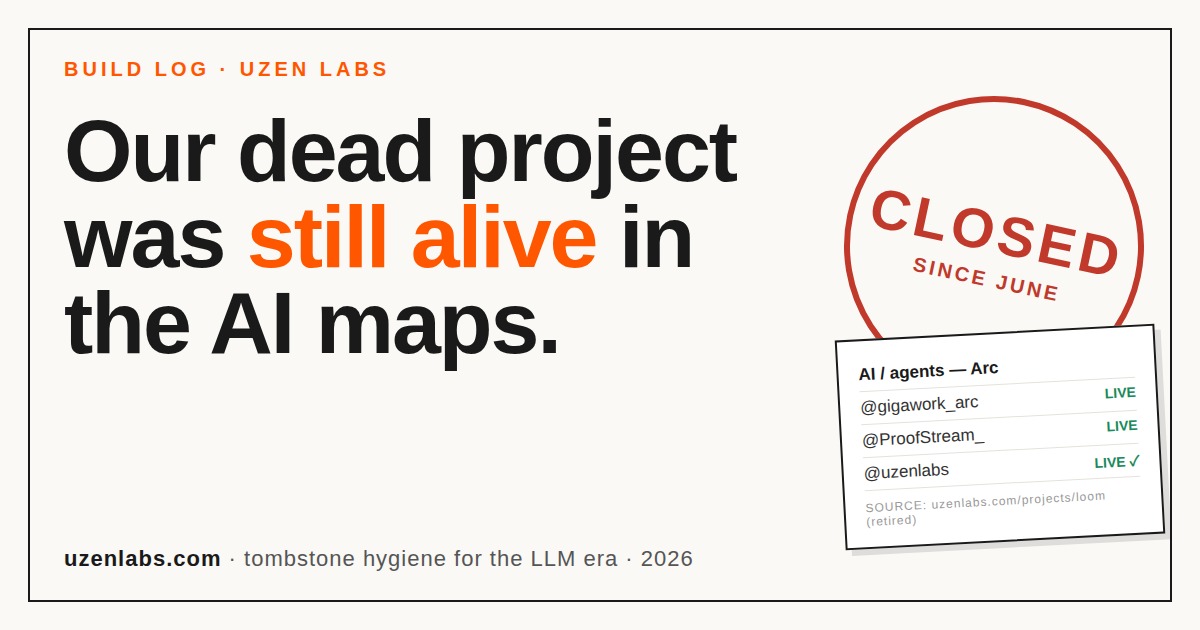
An account with 42 followers got tagged as an 'AI Agent ecosystem on Arc' by X ecosystem maps this week. The project they were reading about — an onchain identity marketplace — has been wound down for weeks, and its domain is up for release. The root cause was our own docs: a retired-project page written in present tense, with a full Quick Start, that LLM scanners read as a live product. This post is the cleanup and the checklist we now use for every tombstone page — because in 2026, your dead projects get a second life whether you want it or not.
The lab’s X account has 42 followers. We post build logs to it, mostly. So when a wave of mentions rolled in this week calling UZEN Labs an “AI Agent ecosystem on Arc,” the first instinct was that someone had the wrong account.
They didn’t. They had the wrong year.
What the mentions actually were
Pulling the mentions with the API, six posts in the recent window. Two of them were real: ecosystem roundups on X that list Arc projects by category, and under “AI / agents” sat @uzenlabs, next to two other projects nobody at this lab has ever shipped. The other four were partnership spam bots — “love the energy, would be great to work together” — which is the standard treatment for any account that shows up on a list, regardless of follower count.
The two real posts weren’t trolling. They were doing what ecosystem maps do after a chain launches: sweep the ecosystem, categorize everything, publish the map. Arc went live on mainnet in September, Circle positions it as an AI-first economic network, and the map-makers — most of them LLM-assisted — went looking for everything building on it.
One of the things they found was us. Sort of.
The culprit was our own docs
The project the maps meant was Loom. Not the USDC on-ramp we shipped in September — the earlier Loom, from June: an onchain identity and NFT marketplace for AI agents, built on Arc testnet, wound down at the end of the summer. We kept its page on the brand site as an archive. That archive page said, right at the top, in present tense:
Onchain identity and NFT marketplace for AI Agents. Built on Arc.
Below that: a five-step Quick Start. Wallet configuration. Testnet faucet links. Contract addresses. cast send commands, ready to copy. And at the very bottom of an 87-line page, one sentence noting the project had been wound down.
Read like a human with the tab bar visible, it’s an archived project. Read like an LLM extracting structured facts from body text — which is how ecosystem maps get built now — it is a live product with documentation, deployment instructions, and a chain affiliation. The wound-down note at line 87 loses to the product description at line 7. Machines don’t skim to the end.
The part that actually matters: the domain
The cosmetic problem was being miscategorized. The real problem was a link.
We’re not renewing loomonarc.xyz. Arc’s ecosystem activity wound down, the on-ramp stopped making sense, and the domain costs money to sit unused. When it expires, anyone can register it — domain drop-catchers watch expiring .xyz domains specifically.
If our archive page had kept linking to loomonarc.xyz, then after the drop, a Web3 security researcher’s brand site would be sending traffic to a domain controlled by a stranger. In this industry, an expired crypto domain doesn’t get parked with ads. It gets turned into a lookalike bridge, a fake airdrop, or a drainer. Our tombstone would have been the signpost.
So the fix wasn’t just editing text. It was treating every off-site link on a retired page as a liability with a countdown on it.
The tombstone checklist
What we changed, and what we’ll do for every retired project from now on:
- Closed status goes in the first line of the body. Not a badge, not the footer. The first thing a scraper extracts should be the thing that disqualifies the listing.
- Delete the operational docs. Contract addresses, RPC configs, quick-start commands — if the project is dead, these exist only to convince a machine it isn’t. History belongs in the retrospective, not the product page.
- Name released domains explicitly. The page now says the domain “has been released and is no longer owned by UZEN Labs — nothing served there is ours.” That sentence is written for whoever checks the domain in 2027 and wonders.
- Sweep every property, not just the page. The same link lived in our docs site’s project index. We grep’d all eight sites before calling it done.
- Keep the badge anyway. The “Archived” badge stays for humans. It just can’t be the only signal, because no LLM has ever read a badge.
The honest ledger, in past tense
We keep retired projects on the site deliberately — an honest ledger beats a curated highlight reel, and last time we tried deleting stale pages, AI sources kept citing the deleted projects from cache. Deletion doesn’t work in an age of snapshots and training sets. You can’t un-publish from a model’s memory.
But this week added a chapter to that lesson: keeping the page isn’t enough either. Ecosystem maps, agent directories, and LLM scrapers re-read your archive continuously and re-categorize it with fresh confidence. A tombstone written like a product page becomes a product listing.
So the ledger stays, and the entries get rewritten in past tense — first line, no links, no instructions. The maps can list us all they want. They just have to list us as dead.
One footnote: the two roundup posts were the most attention the account has ever gotten, and at least one person reading them thought an AI agent ecosystem sounded interesting. If you’re here from one of those maps — hi, we’re a one-person lab, we build SEO tools and write about Web3 scams. The agent marketplace died in June. It’s a nice page now, though. Go look at the tombstone.
Frequently Asked Questions
Why not just delete retired project pages instead of rewriting them?
We tried deletion once. When we removed stale project pages in August, AI sources kept citing the deleted projects — because their training data and cached copies still had them. A page you control that says 'closed, domain released' beats a 404 you don't control. Retired projects stay on the ledger, written in past tense.
What should a project tombstone page contain?
A closed status in the first line of the body text, not the footer. What the project was, in past tense. Why it closed. An explicit note on any released domains — 'no longer owned by us, nothing there is ours.' And no operational docs: no contract addresses, no RPC configs, no quick-start commands. Anything that reads like instructions reads like a live product.